On August 20, 1963, Commercial FM Radio came to Lawrence as KLWN-FM first signed on. The station was built in order to have a full-time signal to broadcast sports and other information, including things like school closings, as the AM station was limited to daytime hours. Because sunrise is at 7:45 AM during the winter, school closings could not be disseminated to the public in a timely fashion via the AM station. Hank Booth, longtime General Manager, had commented that the FM was originally run by a tape, and that no one listened until it was time for KU or Lawrence High Football.
The station started with technical facilities of 17.2 kW at 135 feet up on the KLWN tower on 105.9 MHz. In addition to sharing a tower, from 1963 to 1974, both stations shared the same studio. KLWN-FM essentially simulcasted the AM during daylight hours until 1972. In 1972, the staff began a separate rock programming in the overnight hours, first after the AM sign-off, then it was pre-taped and replayed the next day at 3 PM, later noon. On April 1, 1974, an addition to the station allowed the AM to move into a new studio, with the original studio now utilized solely for the FM station.
In 1971, KLWN-FM applied to increase power to 34 kW. Although the increase was approved by the FCC, it was never implemented, and the Construction Permit was forefeited.
In October of 1978, KLWN-FM applied to increase power to 100 kW on a new 590-foot tower about 2 1/2 miles south and 1 1/2 miles west of the studio. The permit was granted on July 17. On July 31, 1979, KLWN-FM received the new calls of KLZR. The new tower was completed and the new transmitter was put in use in December, with the licence to cover granted on June 2, 1980. The old transmitter was retained on the KLWN tower and was retained.
Tbe 1980s
In 1985, KLZR started minimizing it’s studios and plugged into the Satellite Music Network’s CHR format, using the slogan “Rock ‘N Hits,” and later “The Heat.” The move was, at least initially, unpopular with KU Students, though it held on for most of the 80s.
In 1987, KXXR (now WDAF-FM) wanted to move their 106.5 MHz transmitter closer to Kansas City. In order to do so, they needed to move KLZR to the west. KLZR agreed to move to a new site near Lecompton, about halfway between Lawrence and Topeka. In exchanged, they were able to raise the transmitter height from 590 feet to 775 feet. In addition, KXXR donated their old tower to the Booths to be used at the Lecompton site. The Auxiliary transmitter was moved from the KLWN tower to the 1979 tower, with a power level of 8.4 kW at 590 feet.
On September 6, 1989, KLZR got a surprise when they received a letter from the FCC approving a call sign change to KOLL. Because no one actually requested a call sign change, they got help from Senator Bob Dole to identify and correct the problem. It turns out a Station in the Little Rock area with the calls KZLR requested them (the station was specifically in Maumelle, AR).
Sports Programming
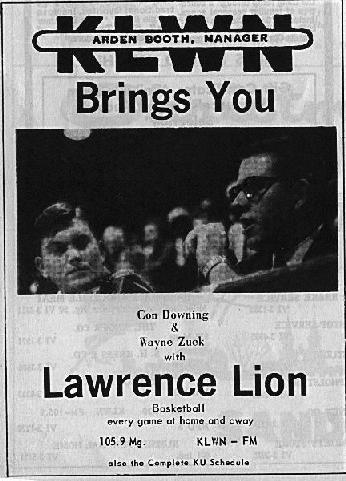
KLWN-FM and KLZR carried football from its inception until the end of the 1995 season. KLWN-FM also carried the LHS and KU basketball games (As the ad indicates). The FM station also joined on the KU sports network. When the KU sports network was superseded by the Jayhawk Network, KLZR, became, and remains (with one glaring exception) the co-flagship station (along with KLWN).
The Modern Rock Era
By the beginning of 1993, the CHR format was in decline, and the Satellite provider flipped KLZR to Hot AC instead. Hank Booth did not want to go in that direction, so on a Sunday in February, they did a format switch stunt. After a KU away basketball game, he went into an Hot AC song, did a scratch-stop, went on the air and said, “Stop, I can’t take this anymore,” played “The End of the World as we Know It,” and began a modern-rock format “105.9, the Lazer.” The Modern Rock format was successful for a while, with a loyal listenership.
New Studios, New Owner, New Format
With the old KLWN and KLZR towers gone from the original site, the Booths looked for a new home for its studios. Aldi foods bought the entire property and prepared to create a store on the property. Meanwhile, the station leased the property back from them until they could pack their bags. The quickly found the old Woodward property in northwest Lawrence at 3125 West 6th Street. It took several months to get the building remodeled for a radio station. Finally, at 1:05 on January 11, 1998, the stations cut the switch at 31st and Iowa and began operations on West 6th. The old studios would be leveled a week later.
The trend in radio has been toward corporate ownership of stations in several different markets. In Mid-1998, Hank rolled with the trend in a way only Hank could. He wanted to make sure, first and foremost, that the stations would remain in Lawrence. He found a family, the Zimmer Radio Group out of Cape Gireadeau, MO, that would do its best to maintain such a commitment. The title was officially transferred to Zimmer on September 1, 1998.
With the Zimmers in control, most of the changes at the station were in the sales department, as the Zimmers advertising approach was to offer strategies instead of spots. One of the bigger, and most controversial, changes was to dump the Modern Rock format for Contemporary Hit Programming. For as many loyal listeners to the Modern Rock format, there were as many people that appreciated what the station was doing, but could not stand the actual music. A survey conducted in 1998 found that a more mainstream format would appeal to more listeners, and CHR was making a comeback, so the station started to move back to CHR in January of 1999. Most people didn’t catch on until Chad Elliot, a specialist in CHR programming, was named the new program director in July. The full switch to CHR was finalized on September 13, 1999. The “flip,” drew a larger protest than before. Part of the reason was that Elliot out and out denied any format change, despite coming to Lawrence to finalize the switchover, not to mention the recent change in ownership. During September 1999, petitions, online an on paper, were filled demanding the format we switched back. In addition, during the last week of September, the window of the KLZR studio was broken twice. By October of 2003, many R&B and hip-hop songs were stricken from the playlist, and KLZR turned back towards a “Hot Adult Contemporary” format.
The Viking Era/Great Plains Media
Rumors persisted for several years that the Zimmers were looking at selling their properties, including the Lawrence stations, to a “bigger fish.” These rumors turned out to be partially true. The Zimmers spun off their properties in Southeast Missouri and Illinois to Mississippi River Radio, a newly formed group consisting of people from the region. The Zimmers subsequently concentrated on the remaining markets, with one brother controlling each market. The Eldest of the Zimmer brothers, Jerry, took control of the Lawrence Stations. Jerry Zimmer adopted the name Viking Communications for the operations under his control. He also worked quickly in acquiring KKYD. Eventually, the name of the company would be known as “Great Plains Media”.
2012 re-imaging
Late in 2011, Jay Wachs, was brought in the new General Manager. One of his first decisions was to re-image the 105.9 frequency. As part of the re-imaging, on January 20, 2012, they performed a stunt where a fan of pop singer Lady Gaga “invaded” the station and forced them to play Lady Gaga music. At 3:00 pm, the station debuted their new “105.9 Kiss FM” image, then proceeded to play 105 hours of music without commercial interruption.
As part of the stunt, the station did not cover the University of Kansas men’s basketball game against Texas on January 21st – leaving the Lawrence-Topeka-Kansas City market without coverage of the game on the FM dial. [WIBW and KCSP were the Jayhawk network affiliates in Topeka and Kansas City, respectively, at the time]
The re-imaging itself did not generate controversy, but the non-coverage of the Texas game did. On January 27, the new GM issued an apology, which included an offer to make good on the missed commercials. 105.9 has broadcast subsequent men’s basketball games.
The last step in the re-imaging was to change the call letters. After over 32 years (save one day in 1989), the KLZR calls were retired and the station assigned the calls KKSW on February 7.
Technical Facilities
Main: 100 kW at 236 m (775 ft) above average terrain. Transmitter located 3 miles west of Lecompton.
Auxiliary: 8.4 kW at 180 m (590 ft) above average terrain. Transmitter located approximately 1 1/2 miles west of the US 59/N 1000 Road interchange south of Lawrence
Studios at 3125 West 6th Street in Lawrence.
Technical History
Original Construction Permit for 17.2 kW/132.5 feet HAAT from KLWN tower near 31st and Iowa applied August 28, 1962, granted November 11, 1962. Licence to cover granted November 21, 1963.
Applied to increase power to 34 kW. Granted May 13, 1971 but subsequently forfeited May 31.
Applied to increase to 100kW/593 feet HAAT from a new tower south of Lawrence October 17, 1978. CP granted July 17, 1979. Licence to cover granted June 2, 1980. Licence to use former facilities as auxiliary facilities granted October 14, 1981
Applied to move to new site 3 miles west of Lecompton, with height increase to 236 m HAAT, January 7, 1987. CP granted September 15, 1987. Licence to cover granted December 10, 1987. Licence to move auxiliary facilities to the 1979 site, 8.4 kW/155 m HAAT granted August 25, 1989